Guide to Crazy Ants in Louisiana
If you live in Louisiana and have seen fast-moving ants pouring across your patio, climbing walls, showing up in bathrooms, or collecting around outdoor equipment, you may be dealing with more than an ordinary ant problem. Crazy ants in Louisiana can become a persistent pest control nuisance because their colonies are large, mobile, and difficult to manage with the same quick fixes people often use for fire ants or sugar ants.
The most talked-about species in the region is the tawny crazy ant, Nylanderia fulva, also called the Rasberry crazy ant or hairy crazy ant in older references. LSU AgCenter notes that this ant has drawn concern in Louisiana because it can form widespread supercolonies with multiple queens and very large worker populations.
For homeowners, property managers, and businesses, the most important thing to understand is this: crazy ant control is rarely a one-and-done treatment. These ants may nest outdoors, forage indoors, move through landscaping, and reappear after surface-level treatments if the larger colony network is not addressed. A practical plan combines identification, sanitation, exclusion, habitat reduction, careful product use, and, in many cases, professional pest control Louisiana support.
Table of Contents
Key Takeaways
- Correct identification matters: Crazy ants is a broad label, and severe infestations may require confirmation by a professional or extension specialist.
- Expect an ongoing strategy, not a quick fix: large, mobile colonies can rebound after surface-level sprays or a single baiting attempt.
- Prevention supports control: reduce moisture, remove nesting cover (clutter, mulch, debris), and seal entry points to make your property less inviting.
- Widespread infestations often need help beyond DIY: professional treatment and, in some cases, neighborhood coordination can improve long-term suppression.
What Are Crazy Ants?
“Crazy ant” is a common name used for ants that move in a rapid, erratic, almost disorganized way rather than forming the neat, predictable trails many people associate with other ant species. In Louisiana, several ants can be mistaken for one another, so the name alone is not enough for a confirmed identification. Tawny crazy ants are especially important because they are invasive, build large interconnected colonies, and can be hard to suppress once established. LSU AgCenter explains that correct identification is important and that specialist confirmation may be needed for hairy or tawny crazy ants.
Unlike red imported fire ants, crazy ants do not build the same obvious dome-shaped mounds in open turf. They also do not sting. That can make them seem less threatening at first, but their numbers often create the real problem. They may crawl over sidewalks, trees, foundation edges, mulch beds, potted plants, HVAC areas, sheds, vehicles, and indoor surfaces in overwhelming quantities.
Why Crazy Ants Are a Louisiana Problem
Louisiana’s warm, humid climate, dense vegetation, frequent rain, and moisture-retaining landscapes create ideal conditions for many ant species. Crazy ants are especially comfortable around places that offer moisture, shade, cover, and access to food. LSU AgCenter describes crazy ants as nesting under objects in yards, in potted plants, compost piles, soil, and other sheltered locations, while also entering homes, businesses, cars, boats, and recreational vehicles in search of food, water, and shelter.
They are also easy to move unintentionally. Infested mulch, nursery plants, soil, yard debris, equipment, construction materials, and recreational vehicles can help spread tawny crazy ants from one area to another. Texas A&M AgriLife Extension identifies human-assisted movement of infested materials as a major factor in the range expansion of tawny crazy ants across Gulf Coast states, including Louisiana.
This is one reason neighborhoods, apartment communities, commercial properties, and rural homes with large landscaped areas can struggle with recurring infestations. If one property treats while adjacent areas remain heavily infested, ants can move back into the treated zone after the treatment breaks down or after conditions change.
How to Identify Crazy Ant Activity
A homeowner does not need a microscope to notice suspicious ant behavior, but visual confirmation by a professional or extension specialist is the safest route when the infestation is severe. Look for these signs:
- Large numbers of small, similarly sized ants moving quickly and unpredictably
- Loose trails that seem less organized than typical ant lines
- Ants appearing on patios, driveways, brick, siding, tree trunks, or landscape borders
- Ants entering around doors, windows, pipes, weep holes, utility lines, or roofline vegetation
- Ant activity around potted plants, mulch, leaf litter, rotting wood, compost, toys, hoses, tarps, or stacked materials
- Recurring ants indoors, especially near moisture sources such as kitchens, bathrooms, laundry rooms, and wall voids
- Dead ant piles after treatment, followed by new ants arriving from nearby areas
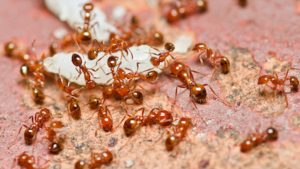
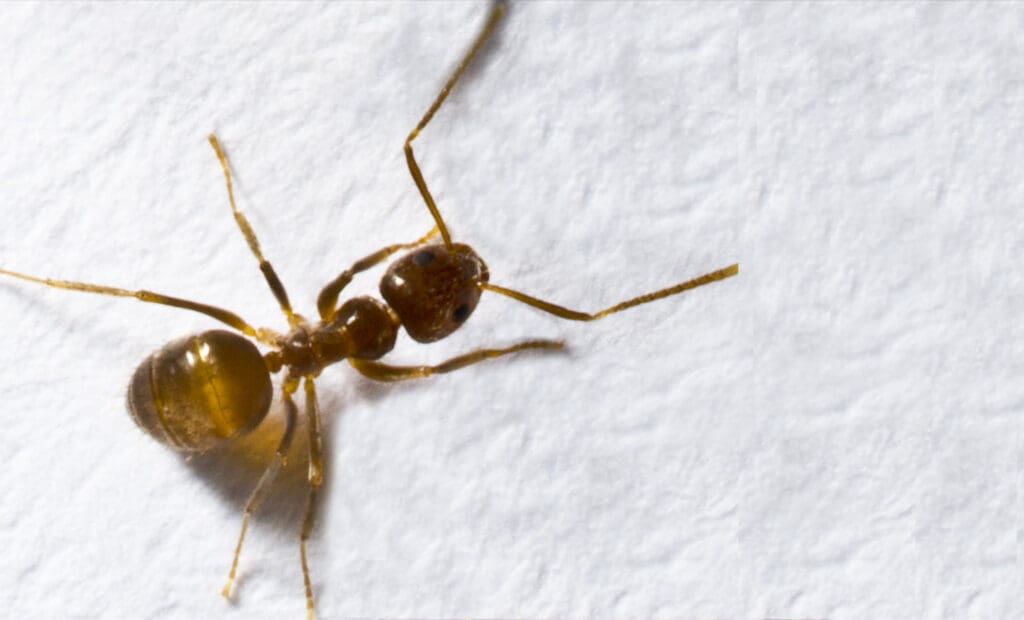
Texas A&M describes tawny crazy ant workers as small, uniformly sized, orange-brown ants with long legs and long antennae that move rapidly and erratically. The same source also notes that high-resolution microscopy may be needed for reliable species-level identification because tawny crazy ants resemble other Nylanderia ants.
Crazy Ants vs. Fire Ants
Many Louisiana residents are familiar with fire ants, so it is natural to compare every outdoor ant problem to them. Crazy ants behave differently.
Fire ants typically draw attention with mounds and painful stings. Crazy ants do not sting, and their nests may be hidden under debris, landscape materials, or protected objects rather than in obvious mounds. Fire ant management often focuses on mound treatments and broadcast baits designed for fire ants. Crazy ant control usually requires a broader approach because colonies may have many queens, multiple nesting sites, and foraging networks that stretch across properties.
LSU AgCenter notes that crazy ants form large colonies with multiple queens, feed on dead insects and honeydew, and can be difficult to control because they are nomadic and form new colonies by budding.
Why They Invade Homes and Buildings
Crazy ants usually start outdoors. When conditions shift, they may move indoors for food, water, shelter, or protection from weather extremes. Heavy rain can flood nesting areas. Drought can push ants toward irrigated landscapes or indoor moisture. Heat can make shaded structural voids attractive. Cold snaps can also drive ants into buildings.
Common indoor attractants include:
- Crumbs and food residue
- Pet food
- Grease and protein residues
- Sugary spills
- Leaky plumbing
- Condensation
- Damp wood
- Indoor plants
- Wall voids near exterior trailing routes
Outdoors, they are often associated with moisture and clutter. LSU AgCenter recommends removing harborage such as fallen logs, toys, overturned boats, pots with soil, woodpiles, lawn tools, and other objects ants can nest in or under. The agency also recommends trimming plants and trees so they do not touch structures, because vegetation can give ants access to roofs and buildings.
Damage and Risks to Watch For
Crazy ants are mostly considered nuisance pests because they do not sting, but that does not mean they are harmless to property. Large infestations can interfere with outdoor living, contaminate interior areas, and create stress for residents who feel like ants are constantly returning.
In heavy infestations, tawny crazy ants have also been associated with electrical equipment problems. LSU AgCenter states that high populations can short out electrical circuits, kill bees, disrupt ground-nesting wildlife, and enter structures in large numbers. LSU AgCenter’s household insect guide also lists crazy ants as pests that may damage electrical and computer equipment and notes that high numbers, particularly tawny crazy ants, can cover yards or landscapes and negatively affect ecological systems.
They may also affect plants indirectly. Tawny crazy ants feed on honeydew produced by insects such as aphids and scale, and Texas A&M notes that they can protect honeydew-producing insects, which may increase pest pressure on ornamental plants, lawns, and some agricultural settings.
Why DIY Treatments for Crazy Ants Often Fail
Many people start with store-bought ant baits or sprays. Sometimes that helps temporarily, especially if the ant population is small and the product matches the ants’ feeding preference. But severe crazy ant infestations usually require more than a bait station near the kitchen or a quick perimeter spray.
There are several reasons DIY attempts may disappoint:
- The visible ants are only a small part of a much larger colony system.
- Nests may be spread across multiple outdoor locations.
- Colonies can bud, meaning part of the colony can split and establish elsewhere.
- Ants may ignore certain baits depending on season, colony needs, or bait freshness.
- Surface sprays may kill exposed workers without reaching hidden queens.
- Untreated neighboring areas can quickly reintroduce ants.
- Overusing repellents indoors may scatter ants and make tracking harder.
LSU AgCenter’s management plan emphasizes that successful management involves accurate identification, sanitation, blocking access to food, eliminating visible nests, and using bait as part of a coordinated strategy. It also states that communitywide or areawide management may be necessary because of the ants’ biology.
A Practical Prevention Plan for Louisiana Properties
Prevention does not guarantee that crazy ants will never show up, but it can make your property less inviting and improve the results of professional treatment.
- Reduce Moisture
Crazy ants favor damp, protected areas. Repair leaky spigots, air-conditioning condensation issues, clogged gutters, and irrigation overspray. Improve drainage where water pools near the foundation. Replace water-damaged wood when possible, especially around siding, window frames, door frames, decks, and sheds. - Remove Nesting Cover
Walk your property and look for anything that stays damp underneath. Move or reduce stacked lumber, landscape timbers, old pots, unused toys, tarps, bricks, stones, and yard debris. Keep compost areas managed and away from the structure when practical. Thin excessive leaf litter near foundations. - Maintain Landscaping
Trim shrubs, vines, and tree limbs away from siding, roofs, gutters, and windows. Avoid heavy mulch piled against the foundation. Keep grass and groundcover maintained so inspection and treatment are easier. - Seal Entry Points
Use exterior-grade sealant where appropriate around utility penetrations, gaps, cracks, and pipe entries. Replace worn weatherstripping. Install or repair door sweeps. Screening attic vents, crawlspace openings, and weep areas should be done carefully so moisture drainage and building ventilation are not blocked. - Inspect Incoming Materials
Before bringing in potted plants, mulch, soil, hay, construction materials, outdoor furniture, or stored equipment, inspect for ant activity. This is especially important if the items came from an area known to have heavy ant pressure.
How Professional Crazy Ant Control Works
A professional inspection should start with identification and mapping. The technician should look for outdoor trails, nesting areas, moisture sources, vegetation bridges, entry points, electrical or equipment concerns, and neighboring pressure. Good crazy ant control is not just about treating where ants are visible indoors; it is about understanding where they are coming from and why they are thriving.
A complete treatment plan may include:
- Exterior inspection and species assessment
- Habitat and sanitation recommendations
- Targeted treatment of active trails and nesting zones
- Perimeter protection around structures
- Baiting when conditions are appropriate
- Follow-up visits during the warm season
- Coordination with property managers or neighboring owners when infestations are widespread
Texas A&M notes that contact insecticide buffer treatments may provide temporary protection, but treatments can be breached within a few months, and larger buffer strategies may be needed around structures embedded in dense tawny crazy ant populations.